


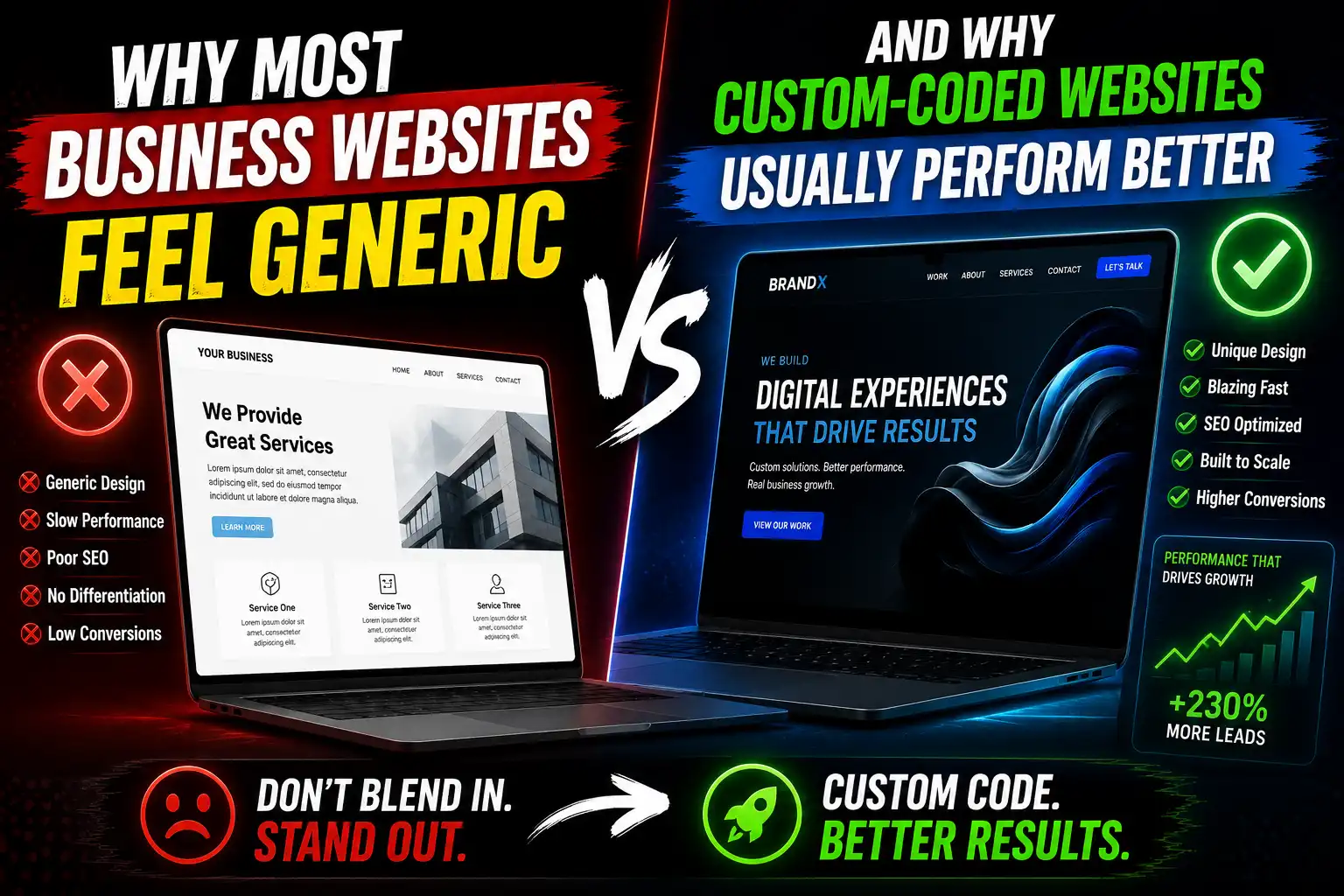
Why Most Business Websites Feel Generic And Why Custom-Coded Websites Usually Perform Better

Why Most Business Websites Feel Generic
Most business websites are not terrible.
They have service pages.
They have contact forms.
They technically work.
But after looking at a few competitors in the same industry, they all start blending together.
Same layouts.
Same stock photos.
Same slow, bloated experience.
And customers notice that faster than most business owners think.
People compare websites quietly.
They open multiple tabs.
They judge credibility in seconds.
They decide which business feels more trustworthy before reading much at all.
That is usually where generic websites lose.
Not because the business is bad.
Because the website creates hesitation.
Most Website Problems Are Actually Trust Problems
A lot of small businesses think their website problem is SEO.
Or traffic.
Or ads.
Sometimes it is.
But many websites lose customers long before SEO even matters.
The real issue is often perception.
A slow or outdated website creates small moments of doubt:
- "Is this business still active?"
- "Do they take their work seriously?"
- "Why does this feel harder to use than the competitor's site?"
- "Should I keep looking around?"
People rarely say these things out loud.
They just leave.
This is why website quality affects conversions far more than many businesses realize.
A website is not just information.
It shapes how the business feels online.
Why So Many Websites Feel The Same
Most modern business websites are built from themes, templates, and page builders.
That is not automatically bad.
For some businesses, it is completely fine.
But templates usually create the same problems over time:
- generic layouts
- bloated pages
- too many plugins
- weak mobile experience
- slow load speeds
- messaging that feels copy-pasted
The website may look decent at first.
But it rarely feels unique to the business itself.
That matters because customers compare businesses emotionally before they compare them logically.
When every website feels interchangeable, trust becomes weaker.
Website Speed Changes How People Judge Your Business
Most visitors will never say:
"This website has poor optimization."
They are not thinking technically.
They are reacting emotionally.
A slow website feels frustrating.
A fast website feels smooth and professional.
That reaction happens almost instantly.
According to Google research, many visitors leave when a page takes longer than 3 seconds to load.
And the problem with many WordPress websites is not WordPress itself.
It is everything added on top of it.
Heavy themes.
Large page builders.
Dozens of plugins.
Extra scripts running in the background.
Over time, websites become heavier and slower without the business owner even realizing it.
Meanwhile, custom-coded static websites are usually much leaner.
No unnecessary systems running constantly.
No plugin stack fighting each other.
No giant theme loading features nobody uses.
That simplicity often creates a noticeably faster experience.
And speed affects more than convenience.
It affects:
- bounce rate
- engagement
- trust
- lead generation
- SEO performance
- mobile usability
A slow website quietly pushes people away.
You can also read more about our approach to custom web development.
Mobile Experience Is Where Weak Websites Get Exposed
Most local business traffic now comes from phones.
And mobile users are impatient.
If the website feels awkward on a small screen, people leave fast.
This is where many template websites struggle.
Oversized sections.
Tiny text.
Cluttered layouts.
Buttons too close together.
Animations slowing everything down.
A custom-coded website is usually easier to optimize properly because every section is intentionally built instead of dragged in from a generic builder.
That often leads to:
- cleaner layouts
- better readability
- faster loading
- easier navigation
- stronger conversion rates
Especially on mobile.
The Hidden Cost Of Cheap Websites
Cheap websites often look cheaper later.
Not on day one.
A year later.
That is when businesses start dealing with:
- redesign costs
- plugin problems
- slow performance
- broken layouts after updates
- poor SEO structure
- weak lead generation
- websites that no longer reflect the business properly
Many businesses focus only on the upfront price.
But the real cost usually appears in lost trust and missed opportunities.
A website that fails to convert visitors becomes expensive very quickly.
Even if it was cheap to build.
If you are comparing options, our custom website pricing page explains how we structure projects.
Good Websites Feel Simple
The best business websites usually feel effortless.
Not because they took less work.
Because somebody thought carefully about:
- what customers need first
- what creates trust
- what should stand out
- what causes confusion
- how people move through the page
Good websites reduce friction.
Visitors should instantly understand:
- what the business does
- who it helps
- why it feels trustworthy
- how to take the next step
That clarity matters more than flashy effects.
Custom-Coded Websites Are Easier To Control
Templates are designed to work for everybody.
Custom-coded websites are built around one business.
That changes a lot.
The structure is cleaner.
The performance is easier to optimize.
The branding feels more intentional.
The messaging becomes more focused.
There is also less long-term maintenance.
No constant plugin updates.
No random compatibility issues.
Fewer security risks.
Less bloat building up over time.
For many service businesses, that reliability matters more than having endless backend features they never actually use.
WordPress Is Not Automatically Bad
WordPress can absolutely make sense.
Especially for:
- large blogs
- membership websites
- ecommerce stores
- content-heavy platforms
- websites needing advanced backend systems
The issue is not WordPress itself.
The issue is that many small business websites are built quickly with generic themes and very little strategy behind them.
That usually creates websites that look acceptable but fail to create trust.
And trust is what drives inquiries.
The Bigger Difference Is Strategy
The strongest business websites are usually not the ones with the fanciest effects.
They are the ones that understand customer behavior.
They understand that people judge businesses quickly online.
They understand that clarity converts better than clutter.
They understand that performance affects trust.
And they understand that websites are part of business positioning, not just design.
That is why custom websites often perform better long term.
Not because custom code is magically superior.
Because the website is built intentionally around the business instead of adapted from a generic system.
Final Thoughts
Most business websites do not fail because the business itself is bad.
They fail because the website creates hesitation.
Customers compare businesses constantly online.
Even small details affect perception.
A slow website.
A generic layout.
A confusing structure.
Weak mobile experience.
All of those things quietly lower trust.
A well-built custom website solves a lot of that.
It feels faster.
Cleaner.
More focused.
More trustworthy.
And for many small businesses, that difference directly affects leads, conversions, and long-term growth.
If your current website feels outdated, slow, or forgettable, you can contact us to talk about improving it.