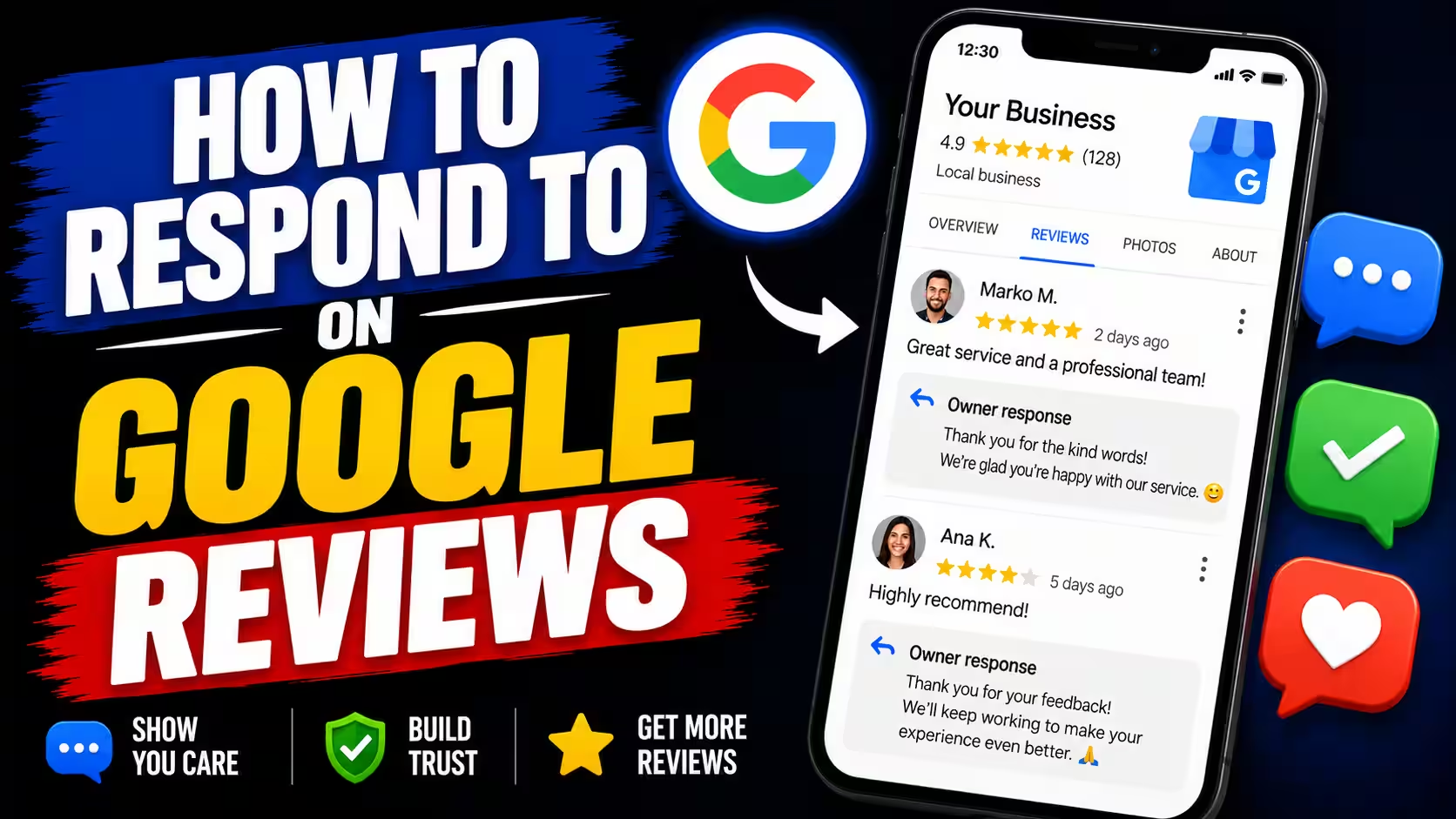
How to Respond to Google Reviews

When a customer leaves a Google review, the response is not just between you and that customer. People who are considering contacting your business can read it too.
That is why a response should be more than an automatic "Thanks for the review." A good reply shows that you read the comment, understood what the customer said, and can communicate professionally, even when something did not go as planned.
You do not need to write long messages or turn every response into an advertisement. In most cases, two or three sentences that address the actual review are enough.
If you are still setting up your profile, see our complete Google Business Profile guide.
How to respond to a positive Google review
The most common mistake with positive reviews is giving everyone the same response. Saying thank you is appropriate, but if every reply sounds identical, it can look as though you have not actually read the reviews.
Instead, mention what the customer specifically appreciated.
If the customer praises how quickly you arrived:
"Thank you for your review. We're glad we were able to get there quickly and resolve the problem. We appreciate your trust in our team."
If the customer praises the quality of your work:
"Thank you for sharing your experience. We're glad you're happy with the final result and the quality of the work."
If the customer praises your communication:
"Thank you for the kind words. We want our customers to know what to expect from the start, and we're glad our approach worked well for you."
If the customer leaves a rating without a written comment:
"Thank you for the rating and for taking the time to leave it. We appreciate your support."
You do not need to include your service name, city, or another promotional statement in every reply. Write as you would speak to a customer in a normal conversation.
What if a review includes a specific complaint?
A negative review does not automatically mean the customer is right about everything. Before responding, separate three situations: a fair criticism, an unclear complaint, and a claim you disagree with.
When the criticism is justified
If you arrived late, made a mistake, or failed to meet an agreement, do not try to minimize the problem. Acknowledge the specific issue and, if possible, explain what you will do to address it.
Example: a customer complains about a delay
"You're right to have expected us to arrive at the agreed time. We apologize for the delay and the inconvenience it caused. We'll review what happened and take steps to help prevent it from happening again."
Use this type of response only if you genuinely accept responsibility and intend to follow through. An empty promise can create another problem.
When it is unclear what happened
A customer might say they were unhappy with your service without explaining what went wrong. Do not guess or immediately start making excuses.
Example: a vague negative review
"We're sorry to hear that you didn't have a good experience. We'd like to understand what happened and see whether we can resolve the situation. Please contact us directly so we can discuss the details."
This shows that you are willing to listen without publicly discussing details you do not yet know.
When you disagree with the claims
If you believe the review does not accurately describe what happened, do not publicly accuse the customer of lying. Keep your response calm and base it on facts you can verify.
Example: a disagreement about the agreed work
"We're sorry to hear that you're unhappy. According to our records, the agreed work covered the items discussed at the time. We'd like to review the details with you and clarify what happened."
Do not use this response unless your records support what you are saying. If you have evidence that a review violates Google's policies, you can report it through your Google Business Profile. Simply disagreeing with a rating does not mean Google will remove the review.
What to do before responding to a negative review
When a comment makes you angry, do not reply immediately. First, check what happened, especially if the work was completed several weeks or months ago.
A useful process is straightforward:
- Check the agreement, messages, invoice, or job records.
- Establish what you can confirm and what you still do not know.
- Decide whether to acknowledge a mistake, ask for more information, or calmly clarify the facts.
- Write a short response without insults, sarcasm, or personal information.
- If the issue requires a longer discussion, continue the conversation privately.
Do not publish a customer's address, phone number, payment details, or other private information in a public reply. Even when you have a legitimate reason to defend your business, revealing such details can do more harm than the negative comment itself.
Should you respond to every review?
It is worth responding to most reviews, but you do not need to leave the same thank-you message under every one. Google recommends replies that are short, relevant, and attentive to the specific information in the review.
If a customer leaves a rating without a comment, a brief response is enough. If they ask a question, describe a problem, or raise a serious concern, the reply deserves more attention.
You do not have to respond within minutes. It is more important to give a considered answer than to leave important complaints unanswered for months.
You can read Google's official guidance on responding to reviews.
Should you include keywords in review responses?
Some local SEO advice recommends mentioning your service and city in replies. The problem comes when the response starts sounding unnatural.
For example, "Thank you for choosing our plumbing services in Austin" may sound as though it was written for a search engine rather than for the customer.
If the service name fits naturally into your reply, there is no reason to avoid it. But do not add keywords solely for SEO. Google advises businesses to keep responses relevant and conversational rather than promotional.
A reply should address the review. It should not be an excuse to repeat your business name, location, and services in every sentence.
Does responding to reviews improve Google Maps rankings?
Responding to reviews can help you communicate with customers and leave a better impression on people considering your business.
However, you should not assume that replying to reviews will automatically move your business to the top of Google Maps. Google identifies relevance, distance, and prominence as the main factors in local rankings. It does not list responding to reviews as a separate factor that guarantees a higher position.
Respond because it helps you manage customer relationships and your business's reputation, not because you expect an automatic ranking increase.
For a closer look at what influences local results, read our guide on how Google ranks businesses on Google Maps.
Reviews are public conversations with future customers
A good response does not have to change the mind of the person who left a negative review. But it can show future customers that you are willing to listen to criticism, acknowledge mistakes, and resolve disagreements without an argument.
Do not try to turn every comment into praise. Respond to what the customer actually wrote, be honest, and avoid promising anything you cannot deliver.
If you want to encourage more genuine feedback from your customers, read our guide on how to get more Google reviews.