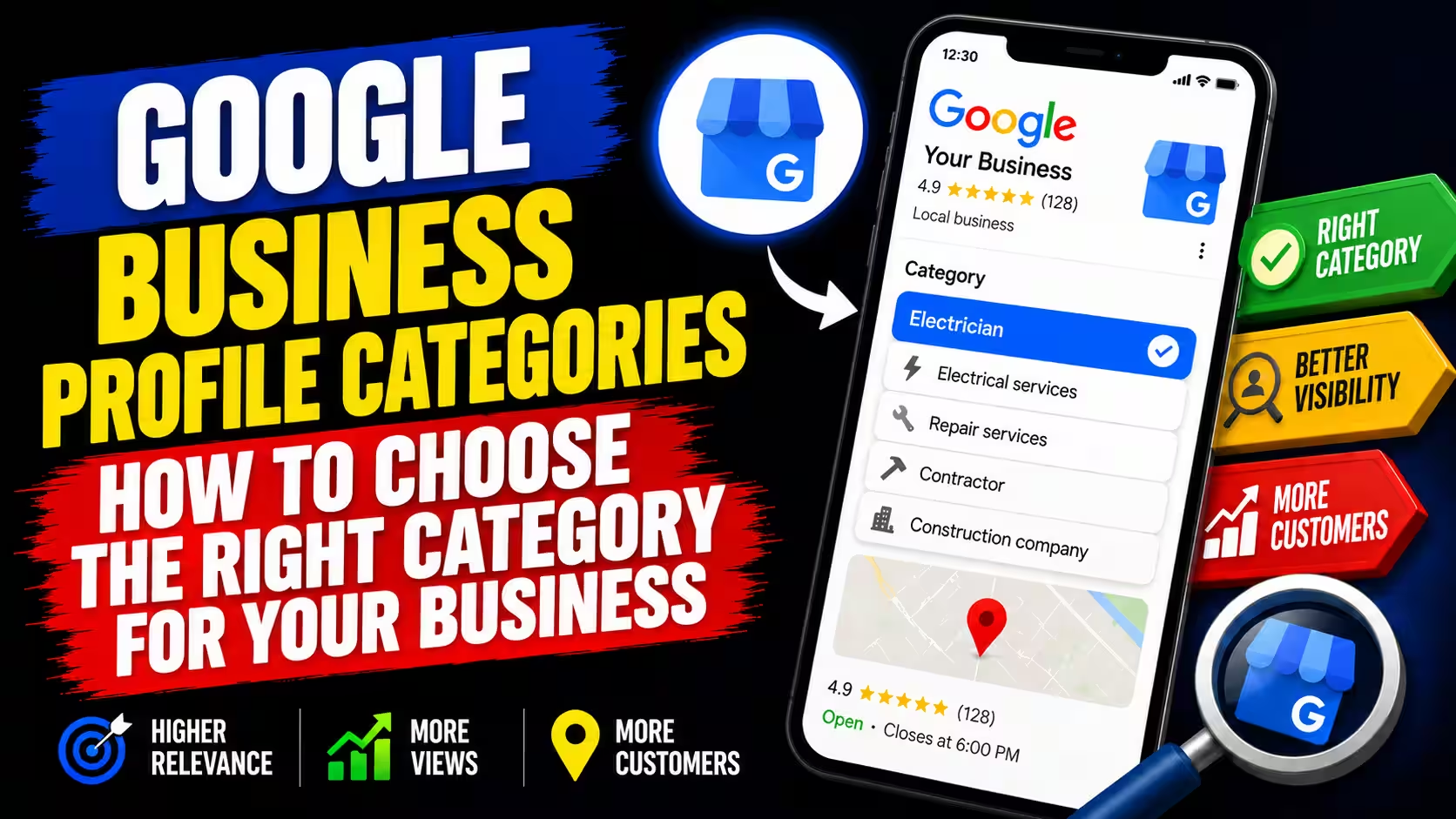
How to Choose the Right Google Business Profile Category

If you want your business to appear for relevant searches on Google Maps, your primary category is one of the first things worth checking.
Your primary category describes what your business mainly does. Additional categories can represent other services you genuinely provide. Choosing the wrong category can make it harder for Google to match your profile with relevant searches.
The goal is not to select the category that sounds broadest or seems to cover the most searches. It is to choose the one that most accurately describes your main business activity.
How to choose your primary category
Start with a simple question: Which service do you want customers to find your business for most often?
The answer should reflect your main business activity, not just the service you think has the highest search volume.
For example, if you mainly provide plumbing services, "Plumber" is a more suitable category than a general category covering several types of construction work.
Choose the most specific available category that accurately describes your business. Google provides a predefined list, so you cannot create your own category by entering any name you want.
Your primary category should describe the business itself, rather than every individual task you can perform.
A broader category does not automatically mean better rankings
A common mistake is choosing a broad category in the hope that it will help a business appear in more searches.
But a broader category is not necessarily a better choice. If you are a plumber, a category covering general construction work is not automatically more useful just because it sounds more inclusive.
The goal is not to choose a category that covers as many services as possible. It is to choose the one that best represents your main activity.
If you provide several services, that does not mean your primary category has to describe all of them. Its purpose is to identify what your business mainly does.
When should you add additional categories?
Use additional categories when your business genuinely provides other types of services that have relevant categories available.
For example, an auto repair shop that also provides tire services may have a reason to list both activities, provided it actually offers both.
Google allows one primary category and up to nine additional categories. That does not mean you need to use every available slot. Add only categories that accurately describe your business.
Do not add a category just because you believe it gets a lot of searches or might attract a wider audience. If the category does not reflect what you do, it can create the wrong expectations for potential customers.
You can read more in Google's official guidance on choosing business categories.
How to check which categories your competitors use
Search Google for the main service you provide and look at the businesses appearing in the local results.
Pay attention to the categories used by relevant businesses that rank well. If several comparable businesses use the same category, that can be a useful clue. It does not prove that the category is the best choice for your business, though.
Do not copy competitors blindly. A company providing a wide range of construction services may have different needs from a contractor who specializes in one type of work.
Use competitor research as a reference point, then make your decision based on the services you actually provide.
Also, remember that categories are only one part of local rankings. Differences in location, relevance, and prominence can affect which businesses appear for a search.
When should you change your category?
Changing your category makes sense if you selected the wrong one originally, your main business activity has changed, or you have moved into a substantially different line of work.
If your current category accurately describes your business, there is no need to change it repeatedly just because your position on Google Maps has changed.
Rankings depend on several factors, and changing a category does not guarantee a better position.
Keep in mind that Google may require you to verify your Business Profile again after certain changes. Before changing a category, make sure the new one accurately reflects your business and that the change is necessary.
Your category is only one part of optimization
Choosing the right category helps Google understand what your business does, but it is not enough on its own to secure strong local visibility.
Your profile should also contain accurate business information, clearly listed services, and up-to-date contact details. Local rankings are influenced by other factors too, including relevance, distance, and prominence.
If you want to review the rest of your profile, read our guide on how to optimize your Google Business Profile. For a broader overview of the profile and its features, see our complete Google Business Profile guide.
When choosing a primary category, do not focus only on which option might bring you the most views. Ask yourself which service you want people to find your business for.
When the answer is clear and your category accurately reflects it, you have made a sound first step toward better local visibility.